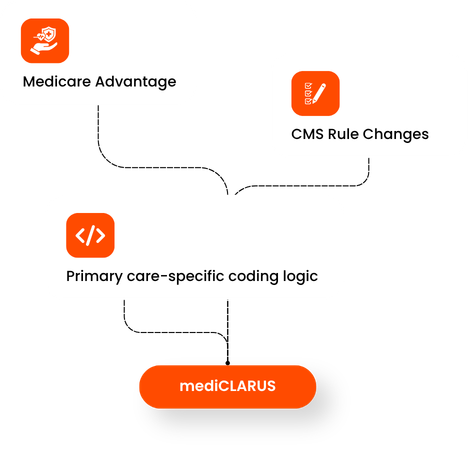
Primary Care needs automation and prioritization, not a bigger version of hospital billing.

A Segment Built Differently, Served the Same

Primary care has high claim volume, thin margins, a payer mix that spans traditional Medicare, Medicare Advantage, Medicaid, and commercial, often within the same patient panel, and coding complexity in E&M levels and risk adjustment.

Generalist workflows have no automation tuned to Primary Care’s volume and no prioritization built around Primary Care’s margins.

For you, it leaves the routine work unautomated, the urgent work untriaged, and the friction unaddressed.

What Gets Missed

Three ways the generic model fails you.

Payer mix complexity

Your panel spans multiple MA plans, each with different prior authorization rules. A generalist platform manages this the same way it manages a single-payer specialty practice, so nothing gets automated and nothing gets prioritized by which payer is causing the most denials.


Risk adjustment blind spots

HCC coding accuracy drives your reimbursement under value-based arrangements. Most RCM vendors never built risk adjustment as a core skill or automated its detection, because it barely matters outside Primary Care.

Patient experience neglect

Generalist vendors optimize for claims, not for the patient who receives a confusing bill afterward. Fragmented statements and low portal adoption become someone else's problem to fix, usually your front desk's.

Trust someone who's lived on both sides of this desk.

Our founder, Ruben Cardenas, spent two decades inside Fortune 500 health plans, building the systems that approve and deny claims. Then he ran a Primary Care clinic and absorbed the cost of those same systems himself.

He built mediCLARUS to close a real gap.

See where your revenue is leaking, automated or not.

Get an RCM assessment

Response within 24 hours.

We'll review your practice details and reach out within 24 hours to schedule your assessment.